

I just signed up for the third time.
On February 23, 2026, Google opened enrollment for the third edition of the Google AI Skills of Tomorrow (Pol. Umiejętności Jutra AI) program. Before I even finished reading the announcement, I was already filling out the registration form.
Not because I have nothing better to do. Because this program changed the way I work with AI — and after every edition, I come back for more.
I participated in edition 1.0 as a regular participant. In edition 2.0, I returned as a community moderator on Discord. Edition 3.0 is now open. If you don't know what this program is yet, keep reading. And if you do know, but you're wondering whether it's worth it — ask someone who's going for the third time. 😏
In brief — Google AI Skills of Tomorrow 3.0: A free, 5-week AI course organized by Google and SGH for employees and owners of SMEs. Conducted in Polish, dedicated to participants based in Poland. Enrollment opened February 23, 2026. Completion earns a Google and SGH certificate. Learning requires 2–5 hours per week. Enrollment requires a written motivation statement (60–200 words). The number of available spots is limited.
What Is the Google AI Skills of Tomorrow Program
Google AI Skills of Tomorrow (Google Skills of Tomorrow AI) is a free, 5-week training program on the practical application of artificial intelligence at work. The organizer is Google Poland sp. z o.o., and the educational partner is Warsaw School of Economics (SGH). The program is conducted entirely in Polish and is dedicated to participants based in Poland.
This is not a course for developers. It is a course primarily for employees and owners of small and medium-sized businesses who want to understand how AI can change their work.
The program includes over 25 hours of content: video lessons, live webinars, quizzes, practical assignments, and a final test. You learn through case studies that you can implement in your company or team while the course is still running.
Program Modules
The curriculum for edition 3.0 has not yet been published. Given that each successive edition was more extensive than the previous one, edition 3.0 can be expected to be the best one yet. To give you a point of reference — this is what the edition 2.0 curriculum looked like:
| Module | Topic |
|---|---|
| 1 | AI Fundamentals — including access to the Google AI Essentials course |
| 2 | Individual productivity and creativity with AI |
| 3 | AI in business development — sales, marketing, customer service |
| 4 | Analytics with AI and critical thinking |
| 5 | Advanced AI — agents, chatbots, cloud console |
| 6 | Managing change — personal and organizational |
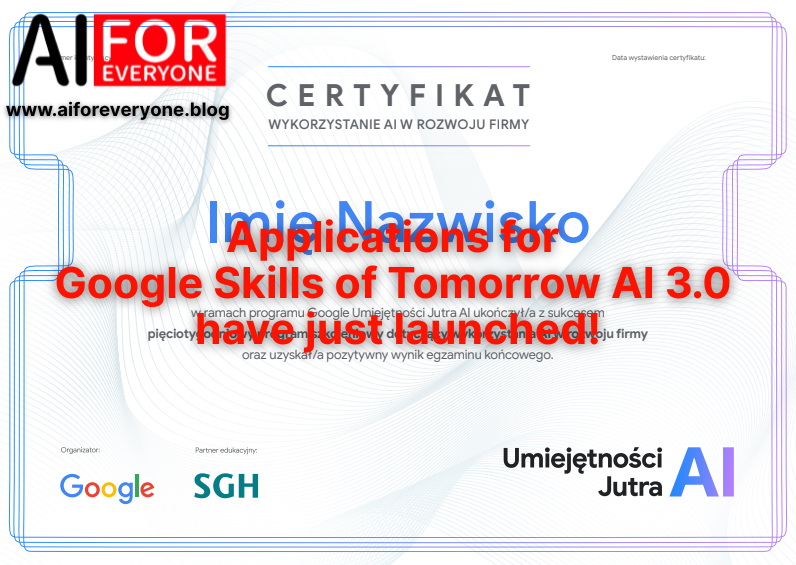
Upon completion, you receive a certificate issued by Google and SGH. Certificate requirements: at least 70% of materials completed and a score of ≥80% on the final test.
And the whole thing is completely free.
Numbers That Speak for Themselves
The first two editions were not a niche experiment.
In total, the program received over 114,000 applications, resulting in 62,000 qualified participants and 47,000 graduates.
Research among graduates shows that:
- 96% plan to apply their new skills in their daily work.
- 68% feel prepared for AI-driven changes within their industry.
- 89% believe they have a solid foundation for using AI tools.
These are results you rarely expect from corporate training programs. And this one is free.
My Experience from Edition 1.0
I signed up for the first AI Skills of Tomorrow in winter 2024/2025, when the program was just launching.
The program was divided into 5 modules containing a total of 19 courses — from the basics of prompting through data analytics to project management with AI. Each week ended with a knowledge quiz. At the end — a certificate.
At that point I was already an active AI user — writing on my blog, testing tools, teaching others. Even so, the program gave me something I was missing in my everyday self-study: structure and consistency. Five weeks, one module per week, clear progress. Not the chaos of YouTube tutorials, but a planned path with a clear endpoint.
I completed all 5 weeks. The certificate landed on my LinkedIn. I wrote about it in more detail in the article Google AI Skills of Tomorrow — How I Became an AI Technology Pioneer.
Edition 2.0 — This Time from the Other Side
When Google opened enrollment for edition 2.0 in June 2025, I returned — but in a different role.
I was invited to moderate the participant community on Discord. I saw the program from the inside: questions participants don't ask publicly, moments when something really clicks, topics that cause the most difficulty.
Edition 2.0 expanded the program with new content — including a deeper look at NotebookLM, multimodal AI and the concept of RAG (Retrieval-Augmented Generation), as well as the ethics and societal impact of AI. The program grew. So did the community.
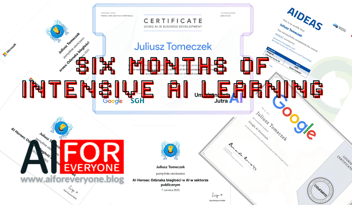
The moderator role gave me a perspective no external reviewer has. I saw what participants genuinely take away from it. And why it's worth coming back. I wrote more about this in the articles 6 Months of Intensive AI Learning and 2025 — A Year of Transformation from Student to AI Architect.
What We Know About Edition 3.0
Enrollment for edition 3.0 officially opened February 23, 2026. The program runs for 5 weeks and covers over 25 hours of materials.
The detailed curriculum for edition 3.0 has not yet been published. While browsing the registration page, I noticed something interesting: the terms and conditions visible on the 3.0 enrollment page still reference edition 2.0 in the header. This is almost certainly a side effect of the organizers being in the thick of managing the launch logistics — everything will be updated shortly. Based on those terms, I already know one important thing: §4 clause 4 explicitly excludes participation by anyone who took part in the previous edition. This means that as a participant of edition 1.0 and moderator of edition 2.0 — who as a moderator also completed the full course — I cannot enroll in 3.0 as a regular participant.
I hope to return as a moderator again — it's the only path back for graduates of the previous edition. The invitation to that role depends on Google, not on me. If I get it, I'll report weekly on the progress of edition 3.0 — what's new in the program, what I observe from the inside, and how the materials translate into practice — from the perspective of someone who has seen this program from both sides at once.
Google and SGH continue their partnership, and the format remains the same: video + live webinars + practical materials + certificate.
The number of available spots is limited.
Who This Program Is For
The program is open to adults who work professionally or run a business. Specific eligibility criteria from the edition 2.0 terms:
- age 18 or older
- employment or ownership of an SME (up to 250 employees), student status, or actively supporting SMEs in AI adoption
- willingness to dedicate 2–5 hours per week for 5 weeks
- desire or current use of AI in daily work
The program is particularly valuable if you've been hearing about AI for months but don't know where to start; you already use tools like Gemini, ChatGPT, or Claude but do so chaotically; you want a certificate that validates specific skills; you work in an SME and are looking for practical applications for your team.
No prior technical knowledge is required.
How to Sign Up for Google AI Skills of Tomorrow 3.0
Registration is done through the Google form:
👉 rsvp.withgoogle.com/events/umiejetnoscijutra
You can also go directly to umiejetnoscijutra.pl.
During registration, you must write a motivation statement — between 60 and 200 words. Recruitment takes place in 5 stages, and you receive a response within 10 business days. It's worth being specific: what you do professionally and how AI could change your work.
Act quickly — in previous editions, the spot limit was exhausted before the planned close of enrollment.
FAQ — Frequently Asked Questions About Google AI Skills of Tomorrow 3.0
Is Google AI Skills of Tomorrow free? Yes. The program is completely free — both participation and the certificate. There are no hidden fees.
How long is the Google AI Skills of Tomorrow program? The program lasts 5 weeks and requires 2–5 hours per week. Video materials can be consumed at your own pace; live webinars are recorded.
Who can sign up for AI Skills of Tomorrow 3.0? Adults (18+) who work or run an SME (up to 250 employees), are students, or actively support SMEs in implementing AI. No prior AI knowledge is required.
Can people from the previous edition sign up for AI Skills of Tomorrow 3.0? No. The edition 2.0 terms (§4 clause 4) explicitly exclude participation by anyone who took part in the previous edition. Graduates of edition 2.0 can only return in the moderator role, if invited to do so by the organizers.
What does the recruitment process look like? Recruitment takes place in 5 stages. A written motivation statement (60–200 words) is required at registration. You receive a response within 10 business days.
What will I receive upon completing the program? A certificate issued jointly by Google and SGH (Warsaw School of Economics). Requirements: completing at least 70% of the materials and scoring at least 80% correct answers on the final test.
Do I need to know AI to get started? No. The program starts from the basics. I completed edition 1.0 with already solid AI knowledge and still got real value from it — the program works for both beginners and advanced users.
I'm Signing Up. Are You?
If I manage to qualify as a moderator, I'll report weekly on the progress of edition 3.0 — what's new in the program, what I observe from the inside, and how the materials translate into practice.
If you want to receive those reports directly to your inbox, subscribe to the AI for Everyone newsletter — link below.
Juliusz Tomeczek — creator of aiforeveryone.blog, participant of Google AI Skills of Tomorrow 1.0 and Discord community moderator of edition 2.0. Since 2024, he has been documenting practical applications of AI for professionals and entrepreneurs. He writes about AI tools, work automation, and building digital products with the help of artificial intelligence.
Data on participation rules, certification, and recruitment comes from the Umiejętności Jutra: AI 2.0 program terms. The edition 3.0 terms will be available on the program website.