
The Zettelkasten, Step by Step: Luhmann's Method Before Apps and AI
Second Brain
12 min readBy Juliusz Tomeczek
The second brain series, episode 1 of 4: the method in the analogue world
🎧 Listen to the podcast about this article
On one of the cards Niklas Luhmann wrote while preparing an article about his own slip-box, there is a sentence: “Überlegungen zu einem Versuch, sich ein Zweitgedächtnis zu schaffen.” In English: considerations on an attempt to create a second memory. The article was published in 1981, long before note-taking apps and artificial intelligence.
Today people talk about a “second brain” mostly in connection with apps, and more and more often with language models that organise notes on their own. In this series I want to show the method from the beginning, so the first episode isn’t about any tool. It’s about wooden boxes full of cards and how they worked. Once you understand the method on paper, you’ll find it easier to use any program later, including one with AI.
Over four episodes I’ll cover the method in the analogue world first, then the second brain in the digital world, and finally how to build your own and how to use it day to day. I take my examples from a lawyer’s work, because it’s a profession that involves a lot of reading and a lot of writing built on arguments. The method works the same way in any knowledge work, though.
Before Luhmann: commonplace books and silvae
The idea of keeping knowledge outside your head is very old. In the Renaissance, scholars kept commonplace books, in which they arranged passages from their reading under headings. Poland has its own version of this tradition: silva rerum, the “forest of things”. These were handwritten books kept by the nobility, especially popular in the eighteenth century, into which people copied anything they considered worth keeping: copies of printed texts and documents, poems, news heard from others. Historians regard their lack of any limits on content as their defining feature.
A commonplace book and a silva, however, collect other people’s thoughts. Luhmann’s slip-box had a different purpose: to develop his own. The whole method rests on that difference.
Who Luhmann was and why his boxes became a legend
Niklas Luhmann (1927–1998) was a German sociologist and the founder of social systems theory. From 1968 to 1993 he worked at Bielefeld University. He left about 600 publications, including more than 40 monographs. From 1951 to 1996 he kept a slip-box that holds about 90,000 cards. The slip-box is now in the university’s archive, and you can browse its scans online in the Niklas Luhmann-Archiv.
Luhmann made no secret of the fact that he owed his productivity to the slip-box. In a 1987 interview he put it this way: “I, of course, do not think everything by myself. It happens mainly within the slip-box.” He treated it as a conversation partner that brings back thoughts you have already forgotten.
The person who spread the method beyond Germany is Sönke Ahrens, author of How to Take Smart Notes (first edition 2017, second, revised edition 2022), which according to the author has sold more than 100,000 copies. In this episode I explain the method following Ahrens and Luhmann’s own cards.
How the slip-box worked
Zettelkasten is German for, literally, a box of slips. That’s what Luhmann called his card index, and it’s now the name for the whole method: notes on separate cards, with fixed numbers and cross-references to other cards.
Two slip-boxes
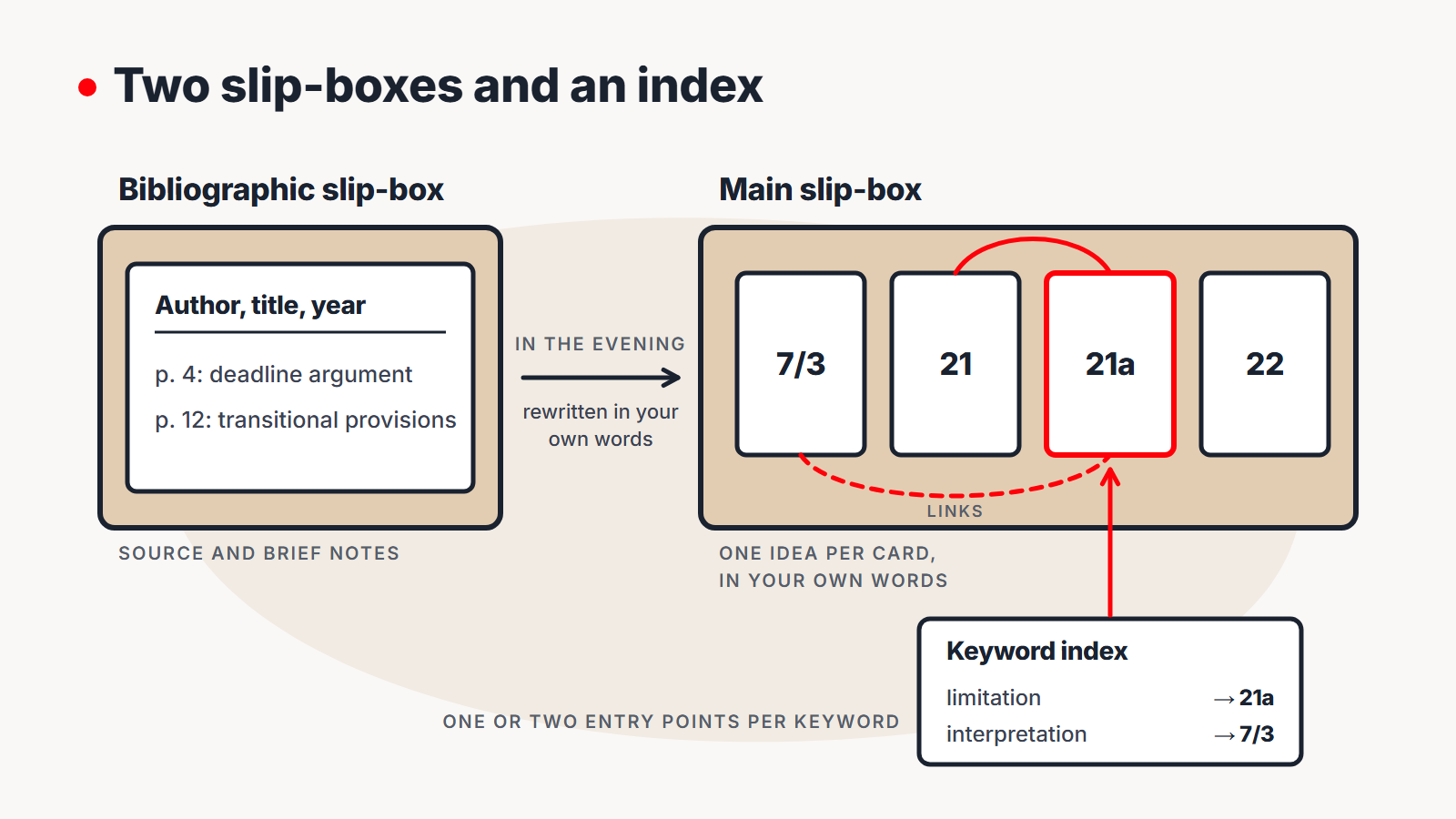
Luhmann actually kept two slip-boxes. In the first, the bibliographic one, he wrote the details of a source on one side of a card and brief notes on the other, along the lines of “page 12 says this, page 40 says that”. He didn’t underline sentences in books or write in the margins. In the evening he went through the notes from the day and thought about what they meant for his own questions. Only then did he write cards for the second, main slip-box.
One idea per card
A main card was A6, so it was roughly the size of a postcard. It held one idea, written in full sentences and in his own words, with a reference to the source. It wasn’t a quotation but a translation of someone else’s thought into his own language, and often already a claim of his own.
A number that means nothing
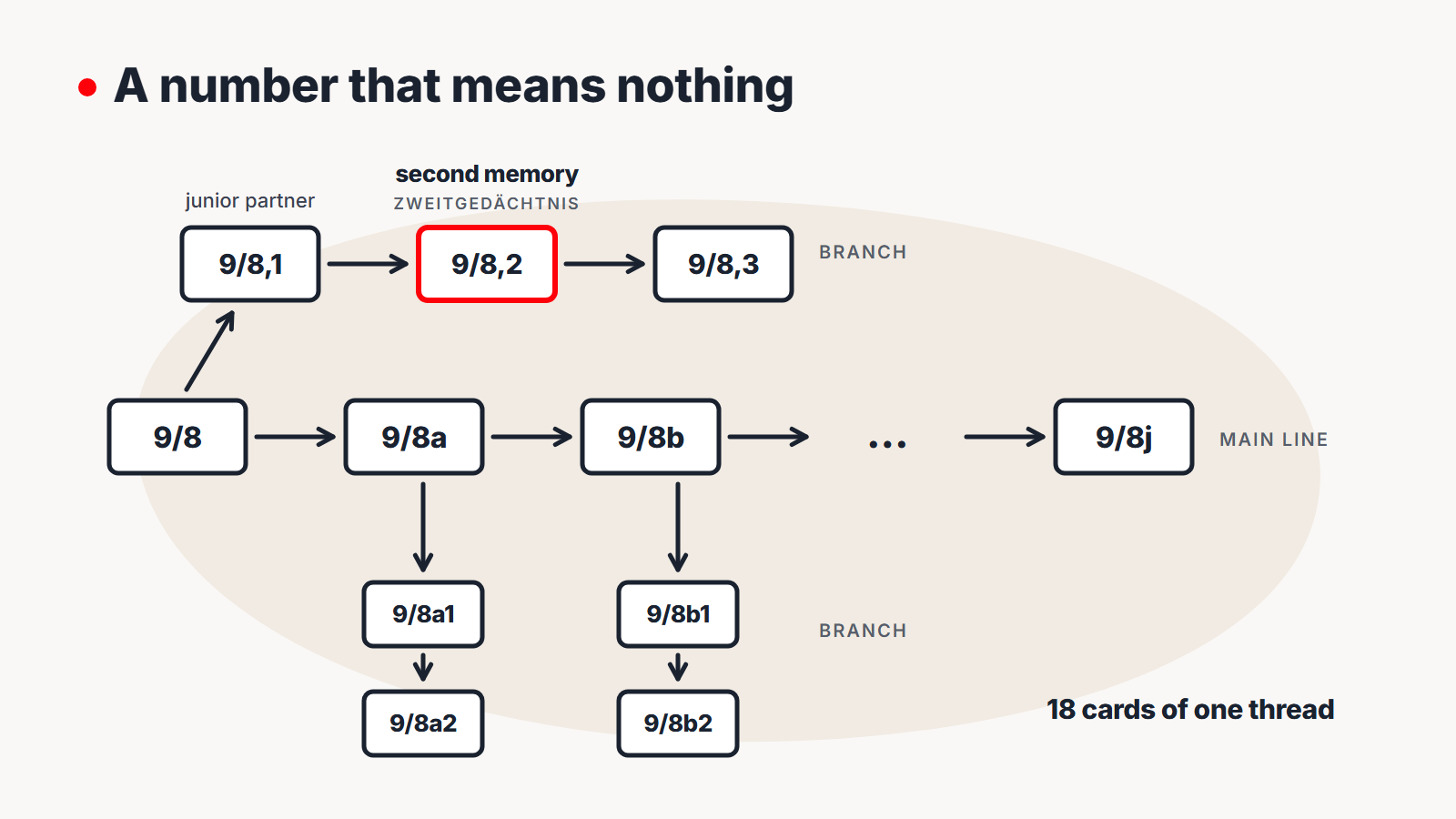
Every card received a fixed number. The number didn’t stand for a topic, only for a place. If a new idea continued card 21, it got number 22. If card 22 already existed, however, the new card went straight behind 21 and got number 21a. Behind it could stand 21a1, then 21a2, and so on. Digits and letters alternated endlessly, so any idea could branch off at any point, without inventing categories in advance.
You can see this clearly in the section where Luhmann was preparing the article I mentioned. The sequence starts with card 9/8. The main line continues through 9/8a, 9/8b and the following letters up to 9/8j. A branch with 9/8a1 and 9/8a2 grows from card 9/8a, a branch with 9/8b1 and 9/8b2 from 9/8b, and a branch with a comma from 9/8 itself: 9/8,1, 9/8,2 and 9/8,3. Eighteen cards in all. In the box, each branch stood right behind the card it grew from. A full English translation of the whole sequence was published by zettelkasten.de.
Links and an index
A card was rarely left alone. Luhmann wrote on it the numbers of other cards, near and far, that it connected to. For topics that had grown large, he wrote overview cards listing the most important numbers. He also kept a keyword index, but a very sparse one: next to each keyword he wrote one or two numbers, an entry point into a line of thought. He found the rest by following the links.
Ahrens sums up this principle in a single question. We usually ask: “Under which topic should I file this?” Ahrens suggests asking: “In which context will I want to stumble upon it again?” The second question leads to connecting notes rather than sorting them.
Types of notes
Ahrens organises Luhmann’s method into four types of notes. The division is his, not Luhmann’s, but it explains well why so many note-taking systems don’t work.
| Type | What it is | Where it goes | How long it lives |
|---|---|---|---|
| Fleeting | a quick reminder of a thought: a line on your phone, a note on a printout | one place for all such jottings | a day or two, then into the bin or into a permanent note |
| Literature | a brief note in your own words of what the text says and on which page | together with the source details | kept, but outside the slip-box |
| Permanent | one idea, in full sentences, understandable without the source at hand | the slip-box, behind the card it relates to | never thrown away |
| Project | everything for one piece of writing: outline, fragments, reading list | the project folder | until the project is finished |
The most important difference is the one between a fleeting note and a permanent one. A fleeting note only reminds you of a thought. A permanent note contains the thought, written so that a year from now you’ll understand it without opening the book it came from.
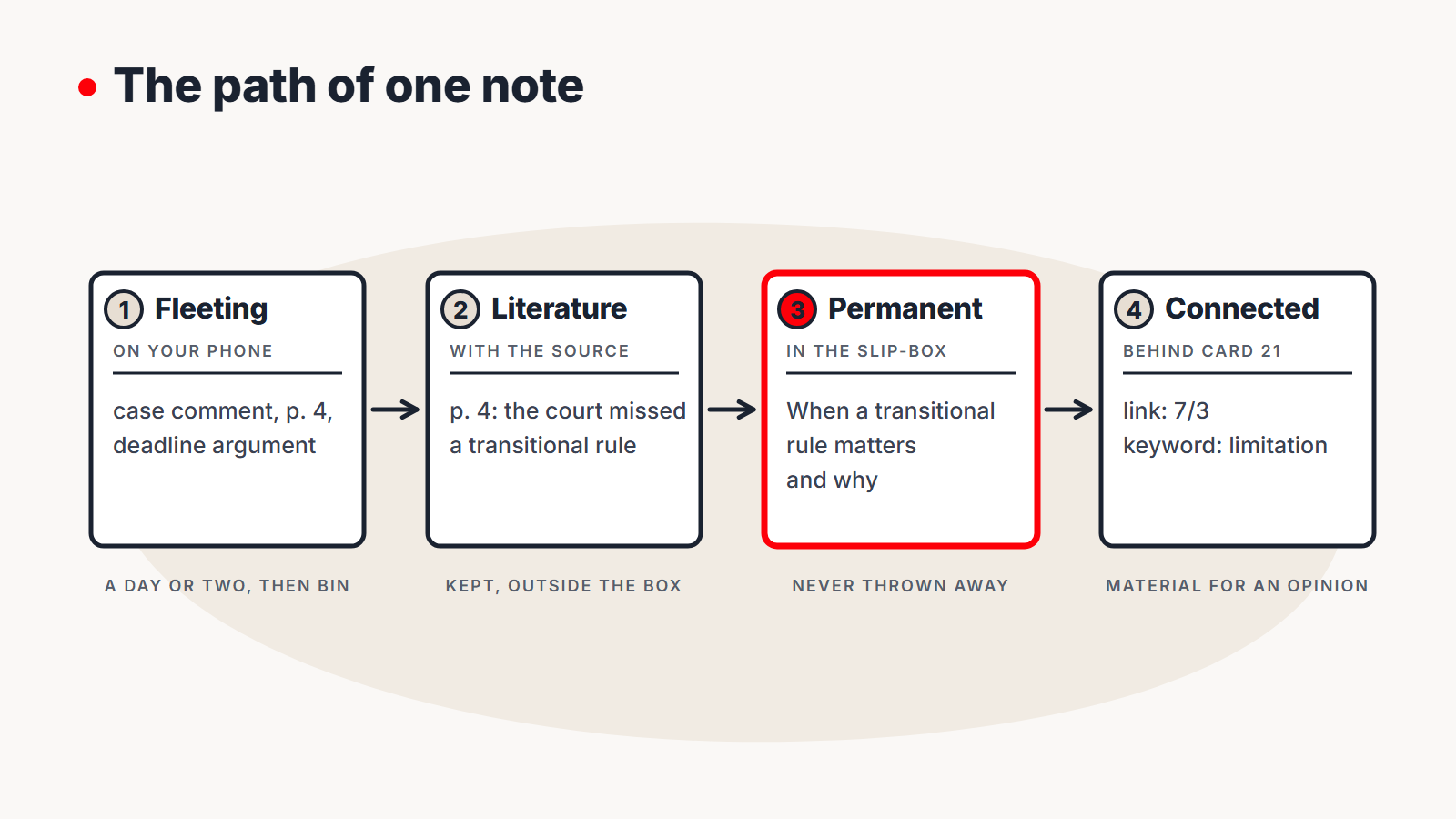
What does this look like in a lawyer’s work? The example is made up, but typical:
- Fleeting note. On the train, you read a case comment on a judgment about the limitation of claims and jot down on your phone: “case comment, p. 4, interesting argument on the deadline”.
- Literature note. In the evening you write two sentences next to the details of the comment, on a card or in a reference manager: on page 4 the author argues that the court overlooked one of the transitional provisions, and quotes its wording.
- Permanent note. For the slip-box you write your own claim: when such a transitional provision matters and why. It must make sense without the case comment.
- Link and index. You place it behind a card from a year ago that records a similar problem from another case, add a link to the card on interpreting transitional provisions, and make one index entry under the keyword “limitation”.
After a few months of evenings like this, the slip-box holds material you can assemble into an opinion, an article or a talk, instead of starting from a blank page.
Why it works
The first reason is simple: writing is thinking, not a record of it. Luhmann put it on card 9/8g: “Ohne zu schreiben kann man nicht denken”, one cannot think without writing. Ahrens also tells an anecdote about Richard Feynman. When a historian called his notebooks a record of his thinking, Feynman objected: “They aren’t a record of my thinking process. They are my thinking process.” The work, he said, had been done on paper.
The second reason has to do with learning. Rereading and underlining give you the feeling that you know something, but they teach little. What teaches better is trying to recall an idea and rephrase it in your own words, and that is exactly what you do with every permanent note. Ahrens quotes the teaching researcher Terry Doyle: “The one who does the work does the learning.”
The third reason is that there are no categories set in advance. Notes from different fields meet in the slip-box, so over time they suggest connections nobody planned. Luhmann worked on several texts at once, and when he got stuck on one, he moved on to another.
What didn’t hold up
Ahrens’s book came out in 2017, and some of the research behind its explanations has not survived later attempts at replication. Willpower did not turn out to be a resource that runs out quickly: a large test in 2021, run in 36 laboratories with more than 3,500 participants, found no such effect. Unfinished tasks are not remembered better than finished ones, as a 2025 meta-analysis showed; what did hold up is that we are more inclined to return to them. Nor was a clear advantage of handwritten notes over laptop notes confirmed. The method’s practical advice doesn’t depend on this research: writing down the next step, arranging your surroundings instead of relying on willpower, and writing in your own words stand up on their own. I mention this because popular productivity books like to repeat striking findings, and it’s worth knowing which of them have solid foundations.
A one-week exercise: a slip-box on paper
Before you install any app, try working the way Luhmann did for a week. You need index cards or A6 sheets and two boxes or envelopes.
- During the day, write fleeting notes in one place: in a notebook or on your phone.
- Whenever you read, make literature notes: the source details on one card, and below them a few sentences in your own words with page numbers. These cards go into the first box.
- In the evening, write one to three permanent notes: one idea per card, in full sentences, so that it makes sense without the source. Throw the fleeting notes away.
- Give it a number and connect it. The first card gets number 1. The next one gets the next number if it continues the previous card, and if it develops an older one, it goes behind that card with a letter (for example 1a). On every card, write the numbers of the cards it connects to.
- Keep an index on a separate card: a keyword and one or two numbers.
- After a week, check the one thing Ahrens considers the best sign that the method works: whether, instead of the question “what should I write about?”, you start running into the problem of having too many topics.
The exercise takes about a quarter of an hour a day (my estimate, not a research finding). Even if you later move to a program, this week will show you the difference between a note that reminds and a note that thinks.
What technology changes
On card 9/8,1 Luhmann asked how to develop a suitable partner in the slip-box, a “junior partner”, because working with staff was becoming more and more difficult and expensive. More than forty years later, that partner can be a language model that reads sources, writes summaries and keeps the links in order. That’s what episode two will be about.
One caveat is worth remembering already. If the one who does the work does the learning, then a slip-box run entirely by AI gives you memory, but not understanding. Even with the best assistant, some notes are worth writing yourself.
If you’re interested in what such a system looks like in a company, not just on your own desk, read What a second brain is, and why anyone would want their own knowledge system on the JT CONSULTING website. For lawyers, I also recommend an earlier article on this blog: AI in the Law Firm: 3 Rules to Give You an Edge. The next episodes of the series will go out in the newsletter. Subscribe to the newsletter so you don’t miss them.
Sources
- Sönke Ahrens, How to Take Smart Notes. One Simple Technique to Boost Writing, Learning and Thinking, second edition, 2022.
- Niklas Luhmann, Kommunikation mit Zettelkästen. Ein Erfahrungsbericht, in: Öffentliche Meinung und sozialer Wandel, eds. Horst Baier, Hans Mathias Kepplinger and Kurt Reumann, Wiesbaden 1981, pp. 222–228.
- English translation of the 9/8 card sequence: zettelkasten.de, 31 October 2022.
- Niklas Luhmann-Archiv, Bielefeld University.
- Tiago Forte, Building a Second Brain, 2022.
- On silva rerum: Joanna Orzeł, “Przeszłość Litwy w księgach silva rerum XVIII wieku”, Zapiski Historyczne 88 (2023), no. 3; Stanisław Roszak, Archiwa sarmackiej pamięci. Funkcje i znaczenie rękopiśmiennych ksiąg silva rerum w kulturze Rzeczypospolitej XVIII wieku, Toruń 2004 (both in Polish).
This text was written with the help of artificial intelligence tools, because that’s how I work every day and what I teach. I have checked every claim in it and I stand behind each one under my own name. The cover and diagrams were made the same way: they’re vector graphics written as code with the same help. The conversation in the recording was generated by NotebookLM from this text, and I listened to it before publishing.
Juliusz Tomeczek, AI for Everyone

About the author
Juliusz Tomeczek
My name is Juliusz Tomeczek. I run the AI for Everyone blog and publish articles here about artificial intelligence.
Related articles

21 min read
5 AI Tools Every Lawyer Should Know in 2026 — Terms & DPA Compared
Comparing ChatGPT, Copilot, Gemini, NotebookLM and Claude for GDPR compliance, DPA coverage and data training policies. Which plan protects client data? Prices, terms, tables.
- #AI for Lawyers

12 min read
AI is lying? No, it's your mistake. 5 principles of prompting for a lawyer
Master prompt engineering to turn AI into a precise legal assistant, enhancing efficiency and accuracy in your legal practice.
- #AI for Lawyers

3 min read
KIRP Recommendations: How to Implement AI Risk-Free in a Law Firm?
Learn how to implement AI in law firms safely and ethically with guidelines from the National Chamber of Legal Advisers (KIRP).
- #AI for Lawyers