
Deepfake
Concept
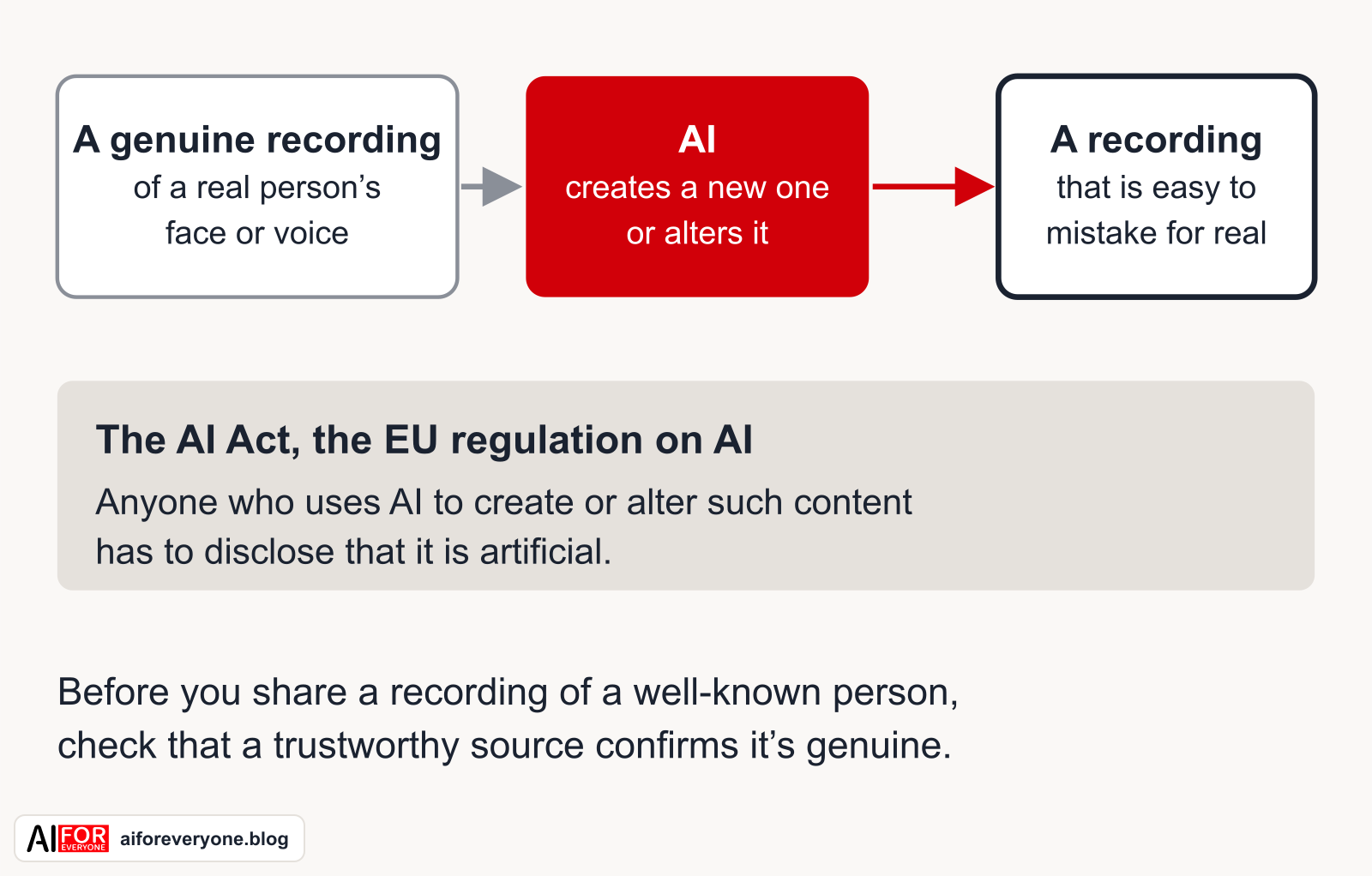
The EU Artificial Intelligence Act defines a deepfake as image, audio, or video content that AI has generated or manipulated, that resembles real people, objects, places, entities, or events, and that would falsely appear to a person to be authentic or truthful. The law requires anyone who uses an AI system to create or alter such content to disclose that it was artificially generated or manipulated.
A widely reported example comes from the first weeks of Russia’s invasion of Ukraine. On March 16, 2022, Meta took down an altered video that falsely showed Ukrainian President Volodymyr Zelensky ordering his troops to surrender. Meta said the video broke its rules against manipulated media. Zelensky quickly responded with a video of his own, saying that only Russian troops should lay down their arms.
In my articles
In my February 2025 article on generative AI, I list realistic deepfakes among the technology’s ethical challenges, along with convincing disinformation and content that closely resembles copyrighted works.
Sources
- Article 3: Definitions, EU Artificial Intelligence Act (opens in a new tab)
- Article 50: Transparency Obligations, EU Artificial Intelligence Act (opens in a new tab)
- Meta takes down deepfake of Ukraine’s President Zelensky surrendering, Taylor Hatmaker, TechCrunch, March 16, 2022 (opens in a new tab)
Related articles
Related entries
Last checked:
All entriesGenerative AI
Generative AI is a kind of artificial intelligence that creates new content, such as text, images, music, speech, or video, in response to a prompt.