
Generative AI
Concept
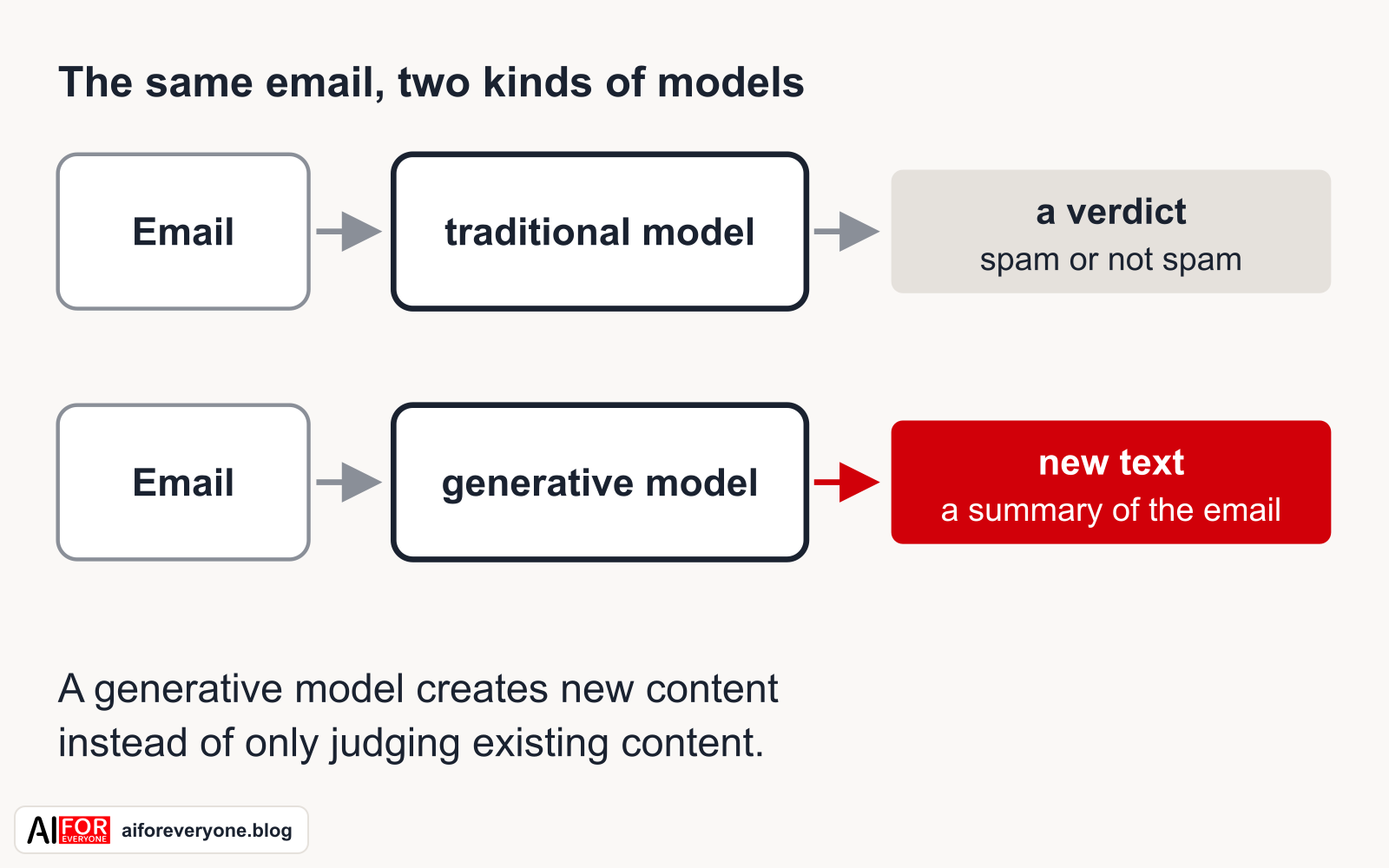
Generative AI, often shortened to GenAI, has no formal definition. Google’s Machine Learning Glossary calls it an emerging field and says most experts agree that generative models create content that is complex, coherent, and original. Generative models include large language models, which write text and answer questions, as well as models that produce images, music, speech, and video. Email is a good example of how generative AI differs from traditional machine learning: a traditional model decides whether a message is spam, while a generative model can summarize it for you.
Several kinds of models power generative AI. Generative adversarial networks pit two networks against each other: one creates examples, and the other judges whether they look real. The transformer is the architecture behind language models such as GPT and Gemini. Diffusion models learn to remove random noise from images step by step, and they create a new image by starting from pure noise and cleaning it up.
In my articles
Generative AI is the main subject of my February 2025 article, where I compare it with artificial general intelligence. I describe what generative AI can do, where it is used, and the ethical challenges it raises, including deepfakes and biases picked up from training data. In that article, I name only GANs and transformers as the foundations of generative AI. In November 2026, I added a correction because I had left out a third approach: diffusion models.
Sources
Related articles
Related entries
Last checked:
All entriesLLM (large language model)
An LLM, or large language model, is a program that has been trained on vast amounts of text and can generate answers and other writing.
GAN (generative adversarial network)
A GAN, or generative adversarial network, is a pair of neural networks trained together. A generator creates new examples, and a discriminator judges whether they look real.
Transformer
A transformer is a neural network architecture built on the attention mechanism, which lets a model connect each word in a text with other words, even distant ones. GPT and Gemini models use this architecture.
Diffusion model
A diffusion model is a type of generative model that starts from random noise and removes it step by step until a picture matching a written description emerges.
AGI (artificial general intelligence)
AGI, or artificial general intelligence, is an AI system that would match humans across a wide range of intellectual tasks rather than in a single narrow field.
Deepfake
A deepfake is an image, audio recording, or video that AI has created or altered to look real, for example, a video of a well-known person saying something they never said.
AI bias
AI bias means that a model picks up stereotypes or unfair patterns about certain people or groups from its training data and then repeats them in its answers or images.