
Diffusion model
Concept
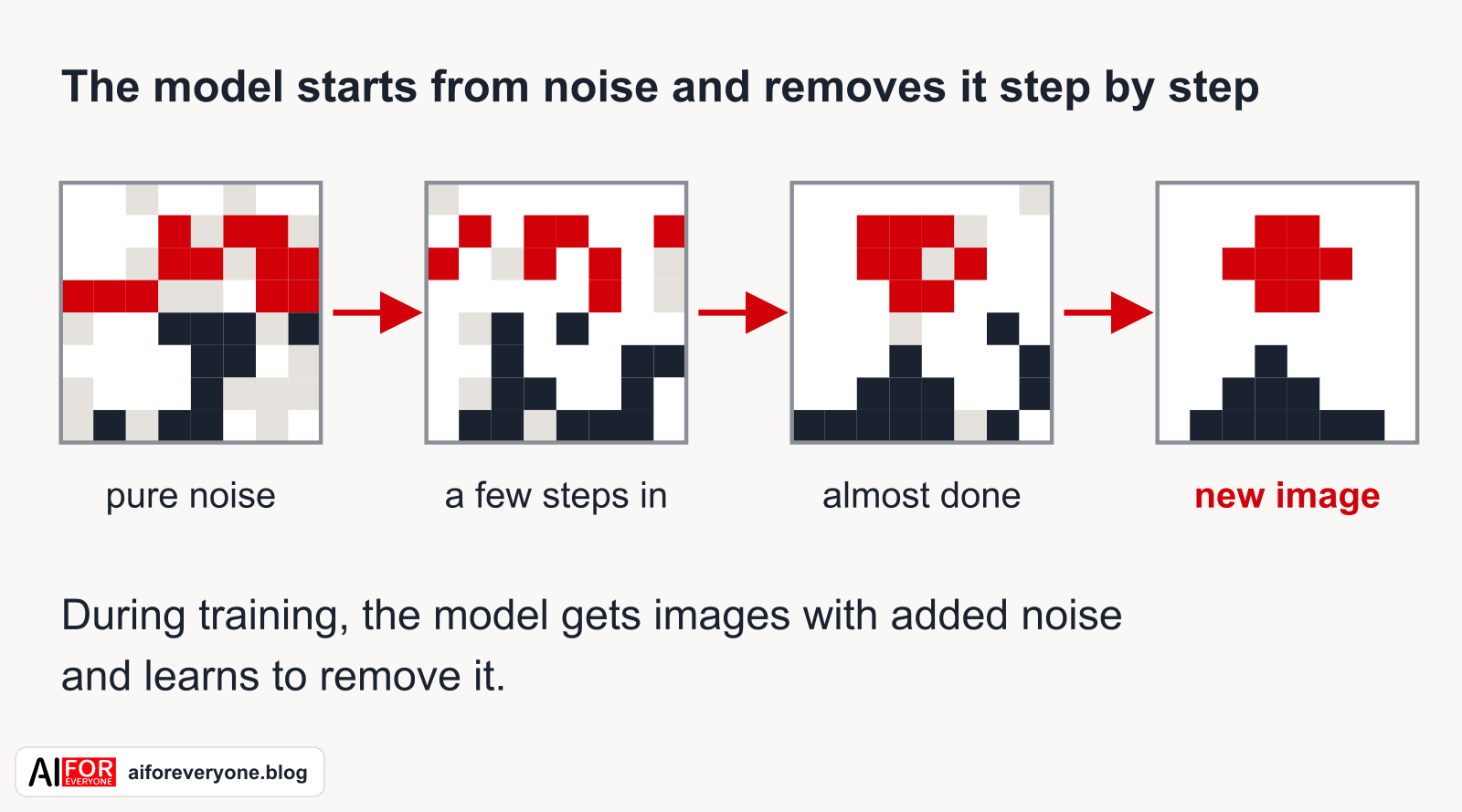
During training, a diffusion model sees images that are gradually buried in noise, and it learns to undo that noise. To create a new image, the model starts from pure noise and turns it into a picture over many steps. In 2020, Jonathan Ho, Ajay Jain, and Pieter Abbeel showed that this approach produces high-quality images. In 2022, OpenAI built its DALL-E 2 image generator on a diffusion model.
In my articles
In my February 2025 article, I name only GANs (generative adversarial networks) and transformers as the foundations of generative AI. In the update note I added in November 2026, I correct that claim, because popular image generators were already built on diffusion models at the time.
Sources
Related articles
Related entries
Last checked:
All entriesDALL-E
DALL-E is a family of OpenAI image models that create a picture from a written description. OpenAI retired them from its developer API on May 12, 2026.