
GAN (generative adversarial network)
Concept
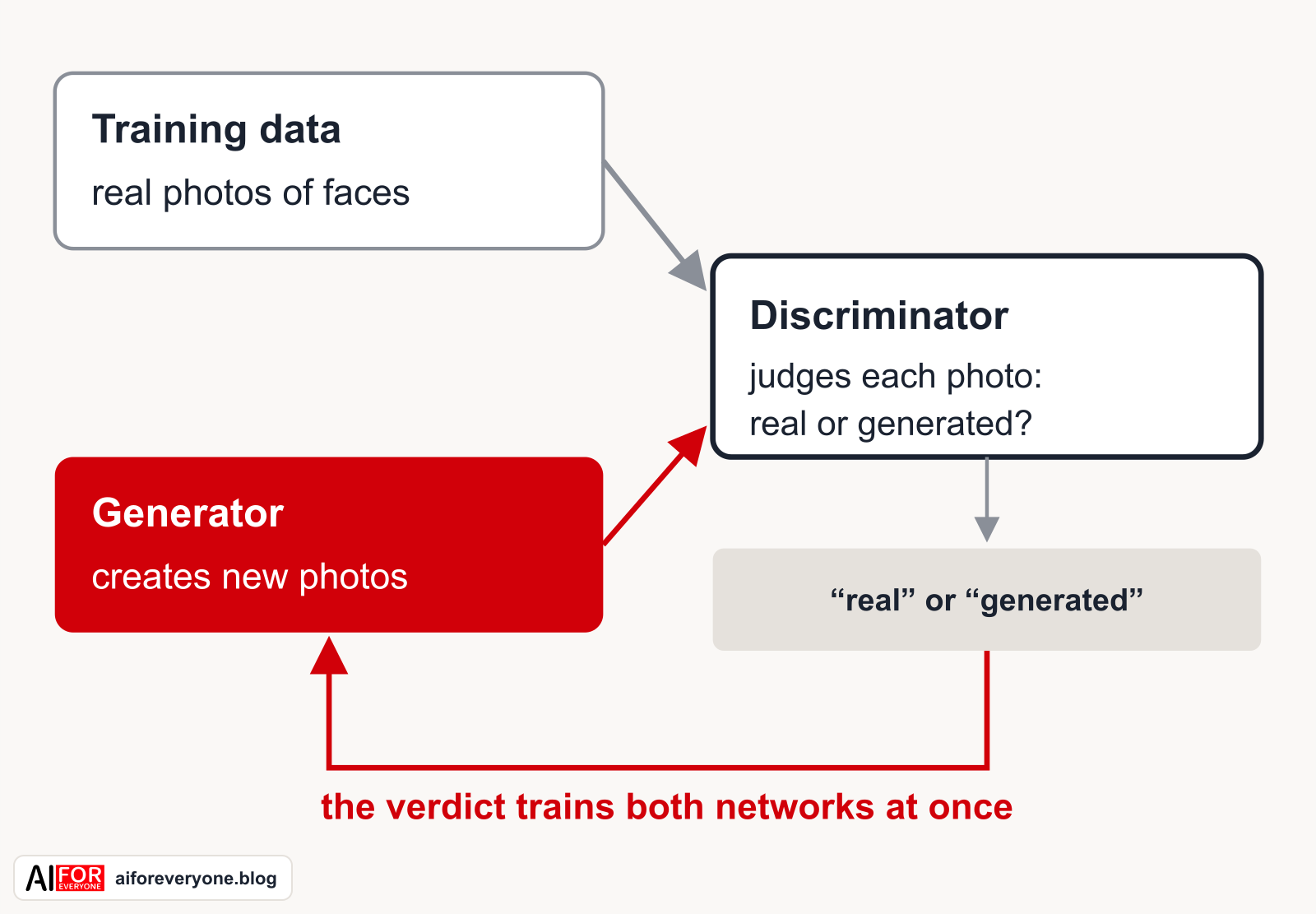
Ian Goodfellow and his coauthors introduced generative adversarial networks in 2014. A GAN consists of two networks. The generator learns to create examples that resemble the training data, for instance, photos of faces, and the discriminator learns to tell real examples from the ones the generator made. The generator’s goal is to fool the discriminator as often as possible. Both networks train at the same time, so each one has to keep up with the other’s progress.
In the 2014 paper, the authors compare the generator to a team of counterfeiters who print fake bills and try to spend them without getting caught, and the discriminator to the police, who try to spot the fakes. The competition pushes both sides to improve until the counterfeits can’t be told apart from real money.
In my articles
In my February 2025 article on generative AI, I compare GANs to an apprentice and a master: a novice artist (the generator) creates images, and an experienced art critic (the discriminator) judges whether they look realistic. The inventors of the method chose a different comparison, one that puts the rivalry first: the two networks compete against each other, like counterfeiters and the police. In November 2026, I added a correction noting that diffusion models are a third foundation of generative AI, alongside GANs and transformers.
Sources
Related articles
Related entries
Last checked:
All entriesDiffusion model
A diffusion model is a type of generative model that starts from random noise and removes it step by step until a picture matching a written description emerges.
Generative AI
Generative AI is a kind of artificial intelligence that creates new content, such as text, images, music, speech, or video, in response to a prompt.