
Reinforcement learning
Concept
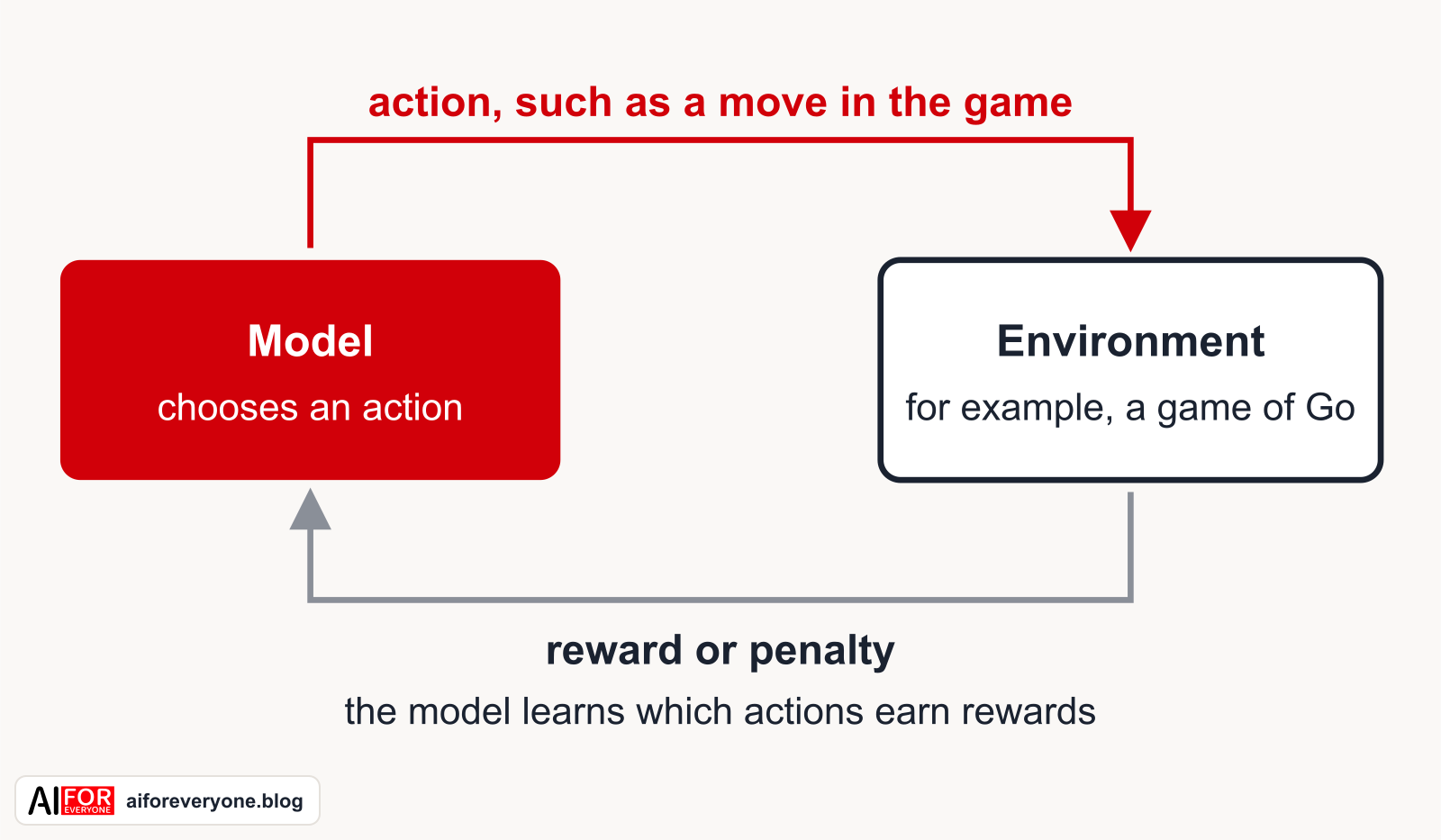
In reinforcement learning, the model isn’t given correct answers. It takes actions, and the rewards or penalties that follow tell it whether those actions were good. In a game, for example, the ultimate reward is usually winning. This is how AlphaGo learned to play Go, and how robots learn tasks like walking around a room.
Reinforcement learning is also used to fine-tune large language models. When feedback from people guides this training, the technique is called RLHF, short for reinforcement learning from human feedback. In a 2022 paper, OpenAI researchers described having people rank the model’s answers and then fine-tuning the model to write the kinds of answers that people ranked higher. Before that step, the same model had been fine-tuned with supervised learning.
In my articles
The comparison table in my February 2025 article on generative AI assigns reinforcement learning only to artificial general intelligence. In the corrections I added in November 2026, I explain that this was already inaccurate on the day the article was published, because by 2022 OpenAI was fine-tuning large language models with reinforcement learning from human feedback.
Sources
- What is Machine Learning?, Introduction to Machine Learning, Google for Developers (opens in a new tab)
- Reinforcement learning (RL) and RLHF, Machine Learning Glossary, Google for Developers (opens in a new tab)
- Training language models to follow instructions with human feedback, Long Ouyang et al., 2022 (opens in a new tab)
Related articles
Related entries
Last checked:
All entriesLLM (large language model)
An LLM, or large language model, is a program that has been trained on vast amounts of text and can generate answers and other writing.
OpenAI
OpenAI is a company that builds AI models and offers them in products such as ChatGPT. It was founded in 2015 as a nonprofit, and its mission statement names AGI explicitly.
Supervised learning
Supervised learning is a way of training a model on examples that come with the correct answers. After seeing many of them, the model can predict the answers for new examples on its own.
AGI (artificial general intelligence)
AGI, or artificial general intelligence, is an AI system that would match humans across a wide range of intellectual tasks rather than in a single narrow field.