
Unsupervised learning
Concept
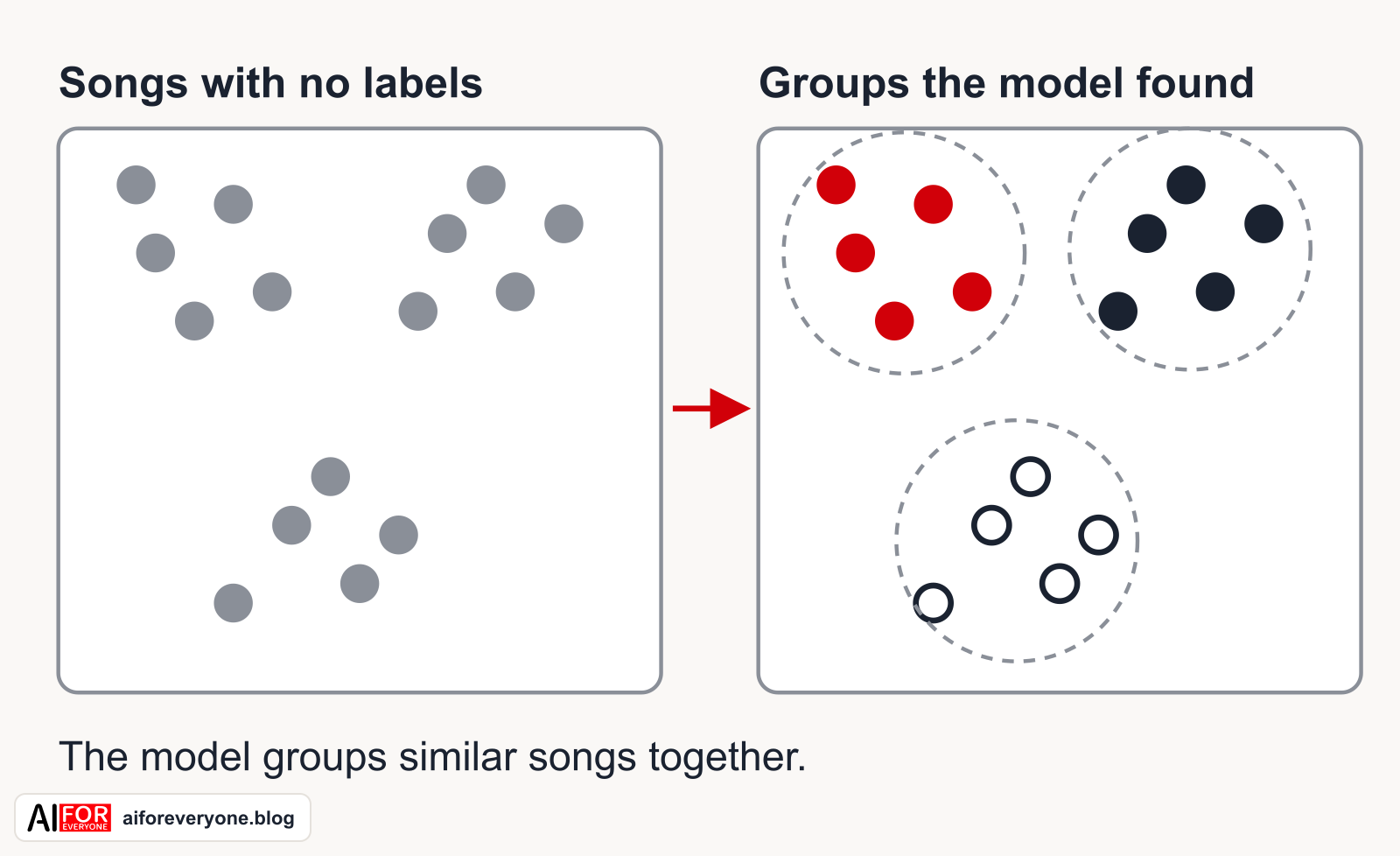
In unsupervised learning, the data usually has no labels, which means no one gives the model the correct answers. The model has to find patterns in the data on its own, and most often it groups similar examples together. Google’s Machine Learning Glossary gives two examples. In the first, an algorithm sorts songs into groups based on properties of the music. In the second, an analysis of millions of shopping carts might reveal that carts with lemons often contain antacids too.
Self-supervised learning is a close relative of unsupervised learning. This family of techniques turns an unsupervised problem into a supervised one by creating labels from the data itself. According to Google’s glossary, some transformer-based models, such as BERT, are trained with self-supervised learning. When only some of the data has labels, the approach is called semi-supervised learning, and when all of it does, it is supervised learning.
In my articles
The comparison table in my February 2025 article on generative AI assigns unsupervised or semi-supervised learning to generative AI, and various types of learning, including unsupervised learning, to artificial general intelligence. In the corrections I added in November 2026, I point out that this split was incomplete, because generative AI also uses supervised learning and reinforcement learning.
Sources
Related articles
Related entries
Last checked:
All entriesTransformer
A transformer is a neural network architecture built on the attention mechanism, which lets a model connect each word in a text with other words, even distant ones. GPT and Gemini models use this architecture.
Semi-supervised learning
Semi-supervised learning is a way of training a model on data where only some of the examples come with correct answers and the rest do not.
Supervised learning
Supervised learning is a way of training a model on examples that come with the correct answers. After seeing many of them, the model can predict the answers for new examples on its own.
AGI (artificial general intelligence)
AGI, or artificial general intelligence, is an AI system that would match humans across a wide range of intellectual tasks rather than in a single narrow field.
Reinforcement learning
Reinforcement learning is a way of training a model by trial and error. The model takes actions, receives rewards or penalties, and learns to act in ways that earn the most reward.