Supervised learning
Concept
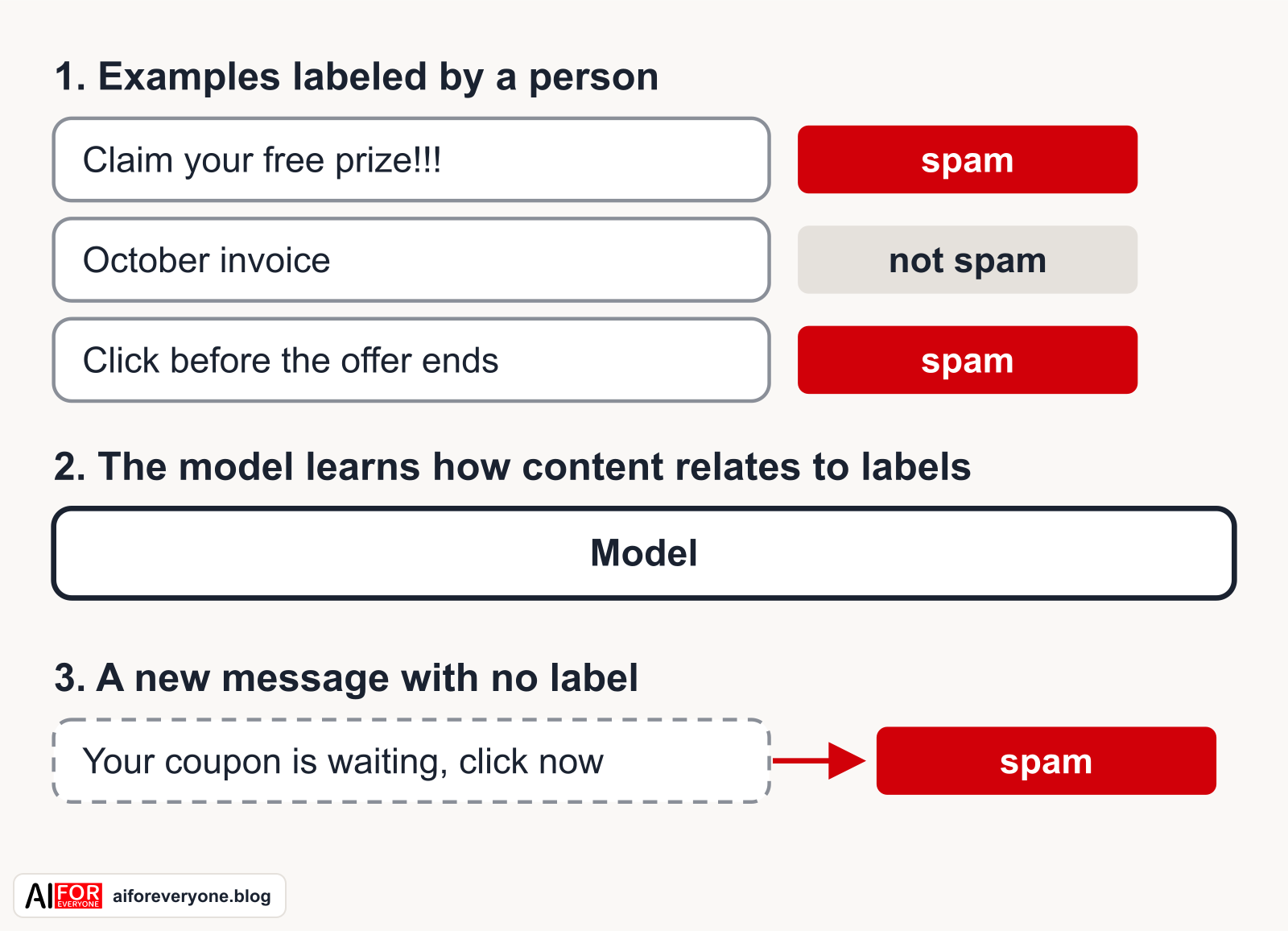
In supervised learning, people pair each example in the training data with the correct answer, which is called a label. The model learns how the data relates to the answers and then predicts the answer for examples it has never seen. A spam filter is a classic example: the model sees many messages marked as spam or as regular email, and it learns to tell which group a new message belongs to. A model that detects whether a photo contains a cat works the same way.
Supervised learning is also used to fine-tune large language models. In a 2022 paper, OpenAI researchers described how they collected human-written examples of the desired answers and used them to fine-tune GPT-3 with supervised learning. Only after that did they fine-tune the model further with reinforcement learning. Unsupervised learning and semi-supervised learning are covered in separate entries.
In my articles
The comparison table in my February 2025 article on generative AI lists supervised learning only under artificial general intelligence and assigns unsupervised or semi-supervised learning to generative AI. In the corrections I added in November 2026, I explain that this split was already inaccurate when the article was published, because back in 2022 OpenAI fine-tuned large language models first with supervised learning, using example answers written by people, and only then with reinforcement learning.
Sources
- What is Machine Learning?, Introduction to Machine Learning, Google for Developers (opens in a new tab)
- Supervised machine learning, Machine Learning Glossary, Google for Developers (opens in a new tab)
- Training language models to follow instructions with human feedback, Long Ouyang et al., 2022 (opens in a new tab)
Related articles
Related entries
Last checked:
All entriesOpenAI
OpenAI is a company that builds AI models and offers them in products such as ChatGPT. It was founded in 2015 as a nonprofit, and its mission statement names AGI explicitly.
Reinforcement learning
Reinforcement learning is a way of training a model by trial and error. The model takes actions, receives rewards or penalties, and learns to act in ways that earn the most reward.
Unsupervised learning
Unsupervised learning is a way of training a model on data without correct answers. The model looks for patterns on its own, for example, by sorting similar examples into groups.
Semi-supervised learning
Semi-supervised learning is a way of training a model on data where only some of the examples come with correct answers and the rest do not.
AGI (artificial general intelligence)
AGI, or artificial general intelligence, is an AI system that would match humans across a wide range of intellectual tasks rather than in a single narrow field.